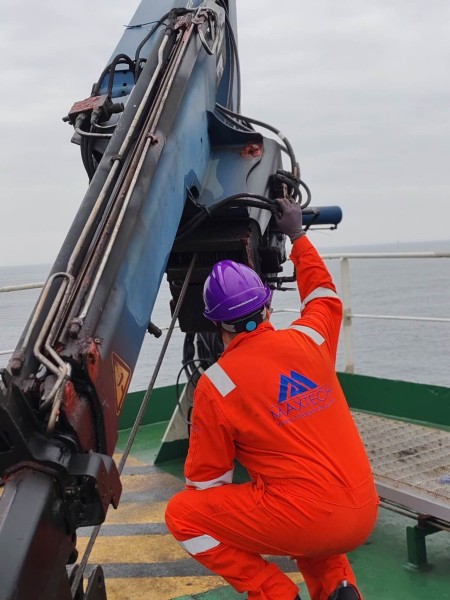
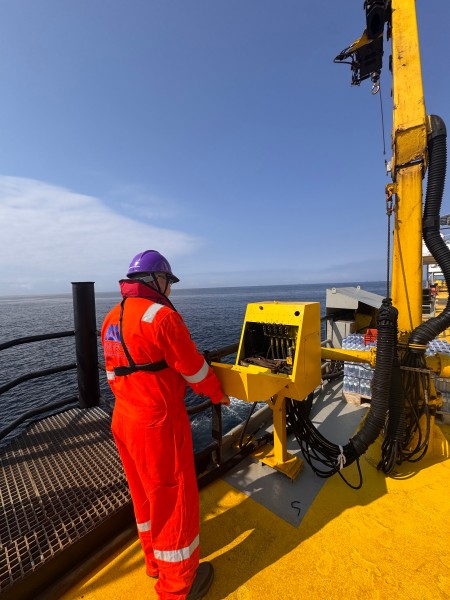
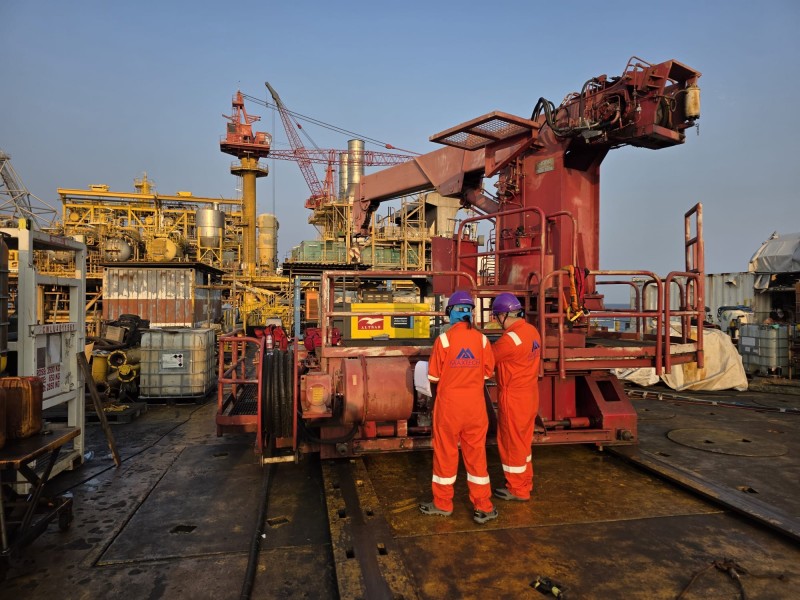
Offshore platform cranes are among the most critical pieces of equipment in the oil and gas industry. They are responsible for all lifting operations on the platform — from transferring supplies and equipment between vessels and structures, to handling maintenance tasks and, in some cases, personnel transfer. Unlike land-based cranes, offshore cranes operate in one of the most demanding environments on earth, where wind, waves, saltwater corrosion, and space constraints create unique challenges.
1. What Defines an Offshore Platform Crane?
An offshore crane is a pedestal-mounted elevating and rotating lift device used to transfer materials or personnel to or from marine vessels and structures. These cranes are typically mounted on fixed (bottom-supported) or floating platform structures used in drilling and production operations.
Unlike land-based cranes, offshore cranes have a fixed location on a structure and are not capable of moving relative to the load. The capacity of an offshore crane depends on three critical factors:
- The structure the crane is mounted on
- The environmental conditions (wind, waves, currents)
- The location of the load relative to the structure
For these reasons, an offshore crane cannot be defined using a single parameter such as "a 50-ton crane." Instead, purchasers must supply the crane manufacturer with extensive information to correctly size the crane.
2. The Regulatory Framework: API Standards
The design, construction, and testing of offshore pedestal-mounted cranes are governed by API Specification 2C (Offshore Pedestal-mounted Cranes), published by the American Petroleum Institute. This specification establishes safe working limits for the crane in anticipated operations and conditions by defining Safe Working Loads (SWLs) based on allowable unit stresses and design factors.
Key requirements under API Spec 2C include:
- Safe Working Load (SWL) at desired lifting radius
- Type of lift — onboard and offboard lifts
- Boom length and configuration — fixed, telescopic, or folding/articulating
- Type of vessel/structure — bottom-supported, ship/barge, TLP, spar, semi-submersible, drillship, or FPSO
- Significant wave height(s) for crane operation
- Wind speed(s) for crane operation
- Crane duty cycle classification
- Hazardous area classification
Additionally, API RP 2D provides recommended practices for the safe operation and maintenance of offshore pedestal-mounted revolving cranes on fixed or floating platforms, support vessels, jackup rigs, semi-submersibles, and other mobile offshore drilling units (MODUs).
3. Types of Offshore Platform Cranes
Offshore cranes come in several configurations, each with distinct advantages for different applications:
Knuckle Boom Cranes
Knuckle boom cranes feature articulated, folding arms that can maneuver around obstacles and operate in confined spaces. They are expected to dominate the offshore crane market due to their compact design, flexible articulation, and superior operational control in confined offshore environments.
Key advantages: Space-saving when folded, excellent maneuverability, precise load positioning in tight spaces
Typical applications: Platform supply, equipment transfer in space-constrained areas, maintenance tasks
Telescopic Boom Cranes
Telescopic boom cranes use multi-section booms that extend and retract, offering adjustable reach and high lifting heights. They are favored for their flexibility, load precision, and compact operational footprint.
Key advantages: Variable reach, high lifting height, precise straight-line extension
Typical applications: Container handling, general cargo operations, applications requiring frequent radius changes
Lattice Boom Cranes
Lattice boom cranes feature an open-grid boom structure that provides a lighter boom-to-load ratio than telescopic or fixed boom cranes. With a lighter boom weight, operators can lift heavier loads.
Key advantages: Light self-weight, excellent rigidity, superior wind resistance, high lifting capacity
Typical applications: Heavy-lift operations, large equipment installation, offshore construction
4. Key Selection Parameters
When selecting an offshore platform crane, the following parameters are essential:
Lifting Capacity and Working Radius
The crane's capability is defined by the combination of SWL and working radius. The maximum SWL decreases as the working radius increases. Purchasers must define both onboard lifts (lifting loads onto the platform) and offboard lifts (lifting loads from vessels alongside).
Duty Cycle Classification
API Spec 2C requires cranes to be classified by duty cycle. Common classifications include:
- Production Duty — For routine platform operations
- Intermediate Duty — For moderate-frequency lifting
- Drilling Duty — For high-frequency, demanding drilling support operations
Environmental Design Criteria
Purchasers must specify:
- Significant wave height(s) for crane operation
- Wind speed(s) for crane operation
- Crane elevation from heel pin to mounting deck and from mounting deck to mean sea level
Hazardous Area Classification
Offshore platforms often have areas classified as hazardous due to the presence of flammable gases or vapors. Cranes and their booms must be designed for the appropriate hazardous area classification.
Offshore platform cranes are sophisticated pieces of engineering that must operate safely and reliably in one of the harshest environments on earth. Understanding the basics — from API standards and crane types to environmental challenges, selection parameters, and safety systems — is essential for anyone involved in the procurement, operation, or maintenance of these critical assets.
Whether you are specifying a new crane for an offshore platform, evaluating maintenance practices, or simply seeking to deepen your understanding of this vital equipment, the fundamentals covered in this article provide a solid foundation for informed decision-making.
Post time: Jul-01-2026