MAXTECH’s core teams across technology, production, and quality control conducted an in-depth study of the A0-IG-L-MS-001 (Rev.0) Lifting Integrity Management System issued by ADNOC Offshore. This comprehensive document, covering three core scenarios—personnel lifting, materials lifting, and subsea lifting—has profoundly reshaped our understanding of offshore lifting equipment standards with its rigorous logic, meticulous requirements, and uncompromising focus on safety. It has not only provided a benchmark for our compliance efforts but also inspired a new level of thinking about product design, manufacturing, and customer-centric service.
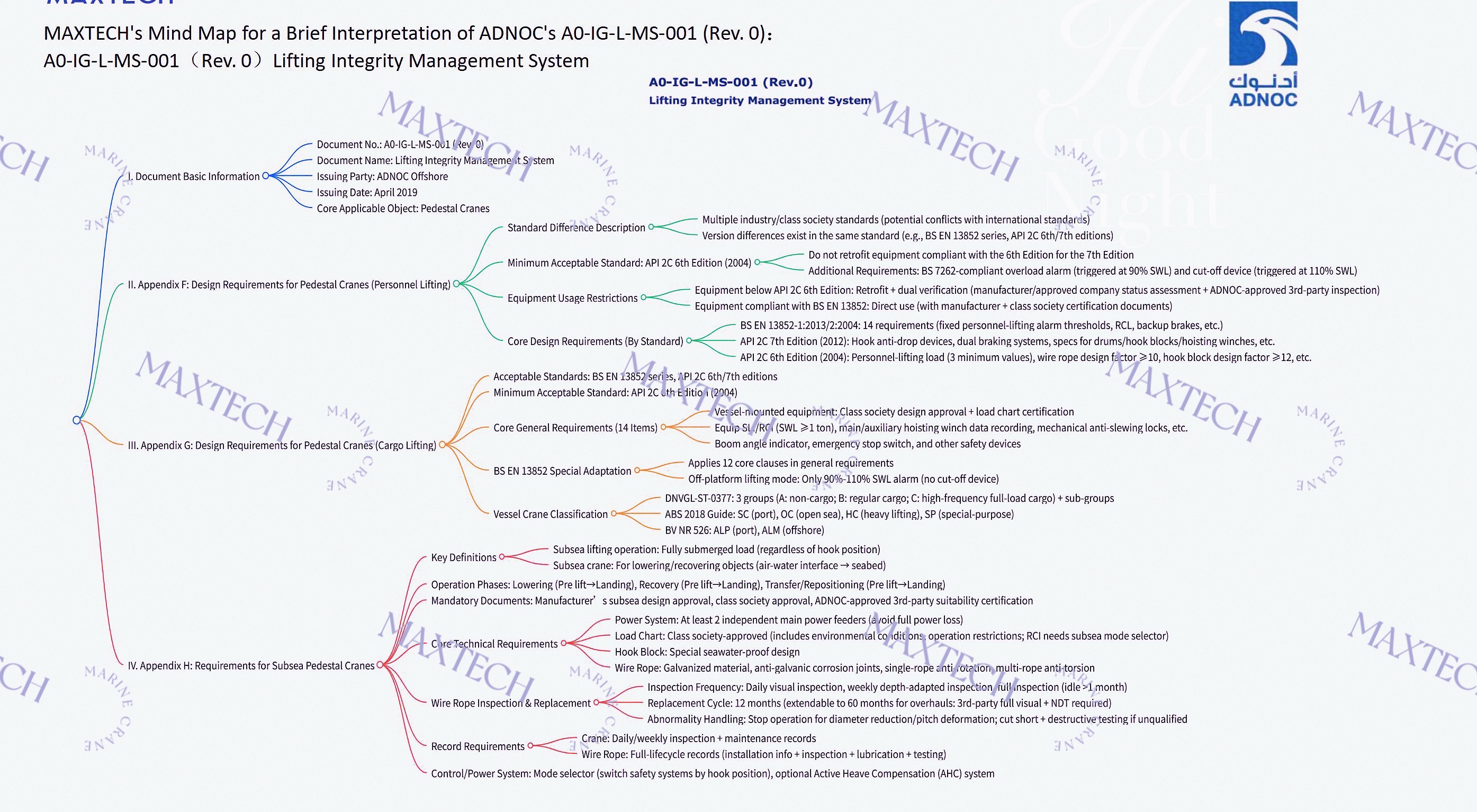
What strikes us most about ADNOC’s system is its masterful balance between standard unification and differentiated adaptation. The document clearly establishes API 2C 6th Edition (2004) as the minimum acceptable standard while systematically clarifying differences between various international standards and their editions—such as the BS EN 13852 series and API 2C 7th Edition (2012). This "clear baseline with flexible upper limits" framework eliminates ambiguity in implementing industry standards and provides clear guidance for equipment compliance. It reinforces our belief that compliance in offshore equipment is not merely about "meeting minimum requirements" but about aligning technical solutions with both customer needs and the essence of global standards. For example, the mandatory requirements for overload alarms (triggered at 90% SWL) and cut-off devices (activated at 110% SWL) for personnel lifting cranes—consistent with MAXTECH’s long-standing commitment to "safety redundancy design"—have strengthened our resolve to enhance safety features across all product lines.
The document’s relentless attention to detail offers a masterclass in "integrity management" as practiced by world-class enterprises. From dual braking systems and independently redundant backup brakes for personnel lifting cranes to mechanical anti-rotation locks and multi-dimensional limit switches for materials lifting equipment; from subsea crane hook blocks engineered to prevent seawater ingress to strict specifications for galvanized wire ropes with a 12-month standard replacement cycle—every requirement directly addresses real-world safety risks. The subsea lifting section, in particular, breaks down operations into deployment, recovery, and transfer phases, with precise mandates for dual independent power feeders, environmental parameter integration in load charts, and daily visual inspections combined with weekly in-depth wire rope checks. This level of detail underscores that reliability in offshore lifting equipment stems not just from core component performance but from rigorous control over every operational detail. It aligns seamlessly with MAXTECH’s philosophy of "customized design + precision manufacturing" and provides a concrete roadmap for optimizing our product lineup.
ADNOC’s refined classification of marine cranes has also deepened our understanding of market demand. Whether categorized by operation scenario and load frequency (DNVGL-ST-0377’s Groups A, B, and C) or by operating environment (ABS Guide 2018’s SC for harbors, OC for open seas, HC for heavy lifting, and SP for special purposes), these classifications reflect a profound grasp of equipment requirements across diverse use cases. For MAXTECH—a specialist in customized offshore cranes (knuckle boom, telescopic, straight boom, etc.) serving clients worldwide across ports, offshore maintenance, and subsea operations—this insight is invaluable. It reminds us that customization extends beyond parameter adjustments to proactive risk anticipation for specific client scenarios. For instance, cranes designed for offshore operations in the Middle East require enhanced corrosion resistance and wind load capacity, while subsea-focused equipment must adhere strictly to the document’s anti-corrosion standards for wire ropes and hook blocks.
The document’s emphasis on "record integrity" has left a lasting impression. Mandating full lifecycle documentation—from daily/weekly crane inspections and maintenance logs to comprehensive wire rope tracking (including manufacturer details, MBL/ABL values, lubrication records, and non-destructive testing results)—highlights that "integrity" in offshore equipment encompasses not just physical performance but also traceability and controllability throughout its service life. This has inspired us to upgrade our after-sales service system: moving forward, we will provide clients with real-time access to equipment design parameters, test data, and maintenance records, empowering them to achieve compliant, data-driven equipment management.
For MAXTECH, studying ADNOC’s Lifting Integrity Management System is more than a technical update—it represents an upgrade to our product philosophy and service model. As a company dedicated to competing in the global offshore equipment market, we recognize that adherence to world-class standards is the foundation of sustainable success. Going forward, we will integrate the document’s core requirements into every stage of product design, manufacturing, and quality control:
- 1. In design, we will strictly comply with API, BS EN, and other international standards, enhancing safety redundancy and scenario-specific adaptation.
- 2. In production, we will refine process controls to ensure every component meets compliance requirements.
- 3. In service, we will establish a full-lifecycle traceability system to deliver professional compliance support to clients worldwide.
Guided by standards and anchored in safety, MAXTECH will leverage this learning experience to continuously advance our technology and services. We are committed to delivering more compliant, reliable, and customer-centric offshore lifting equipment—earning the trust of global clients and solidifying our position as a proud representative of "Intelligent Manufacturing in China" on the international stage.
Author: Alina Zhang
Post time: Jan-08-2026