Marine Cranes are essential core equipment in the maritime industry, widely used in cargo handling, offshore resupply, ship maintenance, maritime rescue and salvage, and other marine operation scenarios. Their operational safety, stability and efficiency directly determine the success of maritime operations, and act as a critical guarantee for crew safety, ship property and smooth operation of the marine ecosystem. In the technical documents of marine cranes, overturning moment, slewing moment, vertical force and horizontal force are four core mechanical parameters, which jointly define the load capacity, operating range and safety boundary of cranes.
As a leading enterprise in the global marine lifting equipment industry, MAXTECH has deeply cultivated the sector for years. With precise control over the four core mechanical parameters, advanced R&D capabilities and strict manufacturing standards, our marine crane products have obtained multiple authoritative certifications including ABS, BV, CCS and CE. Our equipment is widely deployed on container ships, bulk carriers, supply vessels, cruise ships, rescue vessels and other marine platforms, delivering safe, efficient and reliable solutions for global maritime operations.

- Analysis of Core Mechanical Parameters: The Mechanical Cornerstone of Marine Cranes
Marine cranes operate in harsh and variable sea conditions, confronted with complex working conditions such as ship heel and trim, wave impact and wind disturbance. The four core mechanical parameters interact and restrict each other, forming the fundamental basis for crane design, manufacturing and operation & maintenance, as well as the core prerequisite for operational safety. The following is a detailed technical analysis of the four parameters combined with practical marine working conditions.
(1) Overturning Moment: Lifeline of Crane Safety
The overturning moment refers to the moment generated by external loads and various environmental factors during crane operation, which tends to make the crane overturn around the tipping point (generally the edge of the crane base support), with the unit of kN·m.
The core calculation formula:
Overturning Moment = Overturning component moment caused by load + wind load moment + additional moment induced by ship heel and trim.
The load-induced overturning component moment is determined by the product of lifting load, lifting gear self-weight and operating radius. A larger operating radius and heavier lifting load will lead to a higher overturning moment.
In marine operations, ship heel (maximum 5°) and trim (maximum 2°) will significantly increase the overturning moment. As an unstable load, wind force further raises overturning risks. Especially under wind force above Beaufort Scale 4, the wind load acting on the boom and suspended cargo will generate extra overturning moment, posing a serious threat to crane safety.
MAXTECH achieves industry-leading control of overturning moment in marine crane design. All products are developed in accordance with API Spec 2C-2004 Code for Offshore Platform Cranes, CCS Code for Lifting Appliances on Ships and Offshore Installations and other domestic and international standards. Adopting finite element analysis, we accurately calculate the overturning moment under diverse working conditions with different operating radii, loads and sea states. By optimizing the base support structure and boom section design, and applying high-strength steel and stainless steel for key components, we greatly enhance the overall anti-overturning performance of marine cranes.
(2) Slewing Moment: Power Core for Flexible Operation
The slewing moment is the torque that drives the crane’s slewing mechanism (turntable, slewing bearing, driving motor/hydraulic motor) to rotate around the slewing center, measured in kN·m. Its value directly decides the stability, response speed and load capacity of crane slewing movement.
The calculation of slewing moment comprehensively considers eccentric load of suspended cargo, slewing friction resistance, additional resistance caused by wind load and other factors. The core design principle is that the driving slewing moment shall be greater than or equal to the total resistance moment, so as to ensure flexible, stable slewing without stalling or impact.
The slewing mechanism is the key to horizontal cargo transportation for marine cranes, and the stability of slewing moment directly affects operational efficiency. In high-frequency slewing operations such as container loading & unloading and bulk cargo transportation, the uniformity and adjustability of slewing moment effectively improve the operation cycle, reduce cargo swinging, and prevent cargo damage and equipment failure caused by slewing impact.
Benefiting from profound technical accumulation in electro-hydraulic drive systems, MAXTECH realizes precise and intelligent regulation of slewing moment. Our marine cranes are equipped with customized hydraulic motors and planetary reducers, matched with advanced hydraulic control systems. The slewing moment can be automatically adjusted according to working conditions such as load weight and slewing speed, ensuring stable and accurate slewing movement with a response speed over 40% higher than traditional equipment.

(3) Vertical Force: Core Indicator of Load-Bearing Capacity
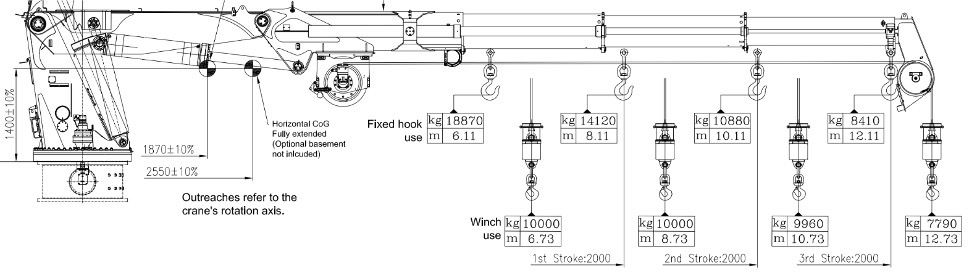
Vertical force refers to the vertical load borne by the crane during operation, mainly including the weight of lifted cargo, lifting gear self-weight, crane structural self-weight, and dynamic load generated during luffing and hoisting (additional load caused by hoisting acceleration), with the unit of kN.
As the core basis for structural design and component selection, vertical force directly determines the rated lifting capacity of cranes. Key components including crane base, boom, steel wire ropes and pulley blocks are all designed for strength based on the maximum vertical force, to avoid plastic deformation, fracture and other faults under rated load and dynamic load.
Vertical force fluctuates violently in marine working conditions: acceleration during hoisting and lowering generates dynamic loads and increases vertical force; ship heaving motion also causes periodic changes of vertical force, resulting in repeated impact on the crane structure.
MAXTECH demonstrates outstanding technical strength in vertical force control. With advanced dynamic modeling technology, we accurately calculate dynamic loads and vertical force fluctuations during hoisting, and optimize the selection and design of core components such as booms and steel wire ropes.
(4) Horizontal Force: Hidden Challenge for Structural Stability
Horizontal force is the horizontal load acting on the crane, mainly derived from wind load, horizontal swinging of suspended cargo, ship swaying and surging, as well as inertial force generated by crane luffing and slewing movement, measured in kN.
Although horizontal force does not directly determine the lifting capacity, it exerts a vital impact on structural stability, base fixation and boom stress. Long-term continuous action of horizontal force may lead to boom bending, base loosening, slewing bearing wear and even major safety accidents.
In complex marine environments, horizontal force features strong uncertainty: real-time changes in wind speed and direction generate irregular horizontal impact force; ship swaying and surging drive the crane to move horizontally and produce inertial horizontal force; horizontal swinging of suspended cargo further amplifies horizontal force, especially in high-altitude operation and strong wind conditions.
Targeted at the characteristics of horizontal force in marine scenarios, MAXTECH adopts multiple protective designs to greatly improve the horizontal force resistance of cranes. First, the optimized streamlined boom structure reduces horizontal force induced by wind load, and strengthens the anti-bending and anti-torsion performance to resist horizontal impact.
- Coordination of Four Parameters & Core Technical Advantages of MAXTECH
Overturning moment, slewing moment, vertical force and horizontal force are not independent but interconnected and coordinated, jointly determining the overall performance of marine cranes.
- Vertical force serves as the foundation, defining the upper limit of load capacity;
- Overturning moment acts as the safety bottom line, restricting the matching of operating radius and lifting load;
- Slewing moment provides power guarantee for operational flexibility and efficiency;
- Horizontal force is a hidden risk factor affecting structural stability and service life.
Only through accurate matching and coordinated control of the four parameters can cranes achieve safe, efficient and stable operation under harsh marine working conditions.
As a professional manufacturer of global marine cranes, MAXTECH takes the four core mechanical parameters as the core of product design, and integrates advanced simulation modeling technology, sophisticated manufacturing processes and intelligent control systems to form differentiated technical advantages:
- Precise Modeling & Simulation: Finite element analysis is adopted to accurately monitor the changes of four parameters under multiple working conditions, eliminating potential design risks and ensuring compliant equipment performance.
- Strict Manufacturing Standards: Key components are made of high-strength steel and stainless steel with special anti-corrosion treatment, adapting to extreme marine environments. All products undergo strict international standard testing to guarantee parameter control accuracy and greatly reduce failure rates.
- Intelligent Control System: Equipped with real-time parameter monitoring system to automatically adjust operating status, realizing overturning early warning, adaptive moment regulation and wind resistance buffering, improving overall operational safety and efficiency, with 24/7 professional technical support.
- Customized Solutions: Tailored crane design and parameter optimization are available for different ship types and operation scenarios, optimizing the matching of four mechanical parameters to meet personalized customer demands.
Conclusion
As the core mechanical parameters of marine cranes, overturning moment, slewing moment, vertical force and horizontal force are the key fundamentals for equipment design, manufacturing and maintenance, and the core guarantee for maritime operational safety. In complex and changeable marine environments, accurate coordination and control of the four parameters are essential to realize safe, efficient and long-term stable operation of marine cranes.
With years of deep engagement in the marine crane industry, MAXTECH adheres to technological innovation and quality-oriented development. Relying on precise parameter control, independent R&D capability and strict quality management, we provide high-quality marine lifting equipment and customized one-stop solutions for the global maritime industry.
From high-efficiency cargo handling at container terminals and accurate offshore material resupply to emergency maritime rescue, MAXTECH marine cranes deliver superior performance and reliable quality all the time. We continuously empower the high-quality development of the global maritime industry and strive to become the most trusted partner in the marine engineering sector.
Post time: May-09-2026