A marine crane (deck crane) performs three basic motions under rated load: hoisting, luffing, and slewing. Together, they enable cargo transfer between ship and shore. But how does it actually work?
I. The Power Source – Hydraulics
Most modern marine cranes use hydraulic drive.
A diesel engine or electric motor drives a hydraulic pump, which converts mechanical energy into pressurised oil flow.
This high‑pressure oil is delivered through valves and pipes to actuate cylinders and motors.
The system is compact, powerful, and allows smooth, infinitely variable speed control.
Think of the pump as the "heart" and the oil as the "blood" – delivering power to every moving part.
II. The Three Basic Motions
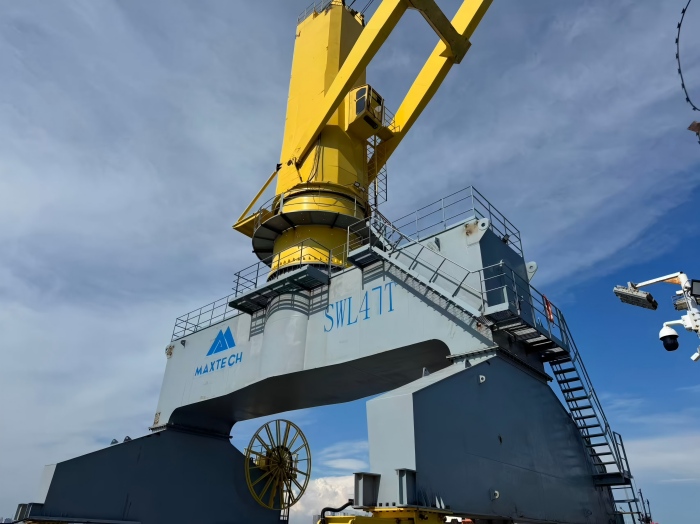
1. Hoisting (up/down)
A hydraulic motor turns a winch drum, winding or unwinding wire rope to raise or lower the hook.
Speed is adjustable, with maximum speeds typically up to 30 m/min.
2. Luffing (boom angle)
A hydraulic cylinder extends or retracts to change the boom's elevation angle (typically 0°–75°).
This changes the working radius – how far the crane can reach.
3. Slewing (rotation)
A hydraulic motor drives a pinion gear around a large slewing ring, rotating the entire port crane 360°.
This covers a wide area, serving both forward and aft holds.
These three motions can be operated individually or simultaneously for coordinated lifts.
III. Control – From Joystick to Action
The operator sits in the cabin and uses joysticks and buttons.
Right joystick – controls hoisting (up/down)
Left joystick – controls slewing (left/right)
Luffing – controlled by an additional lever or buttons
Modern cranes use electro‑hydraulic proportional control. The system responds in milliseconds, with positioning accuracy as fine as ±5 mm.
IV. Safety – Built‑In Protection
Marine cranes face heavy loads, wind, and vessel motion, so safety systems are essential:
Overload protection – alarms and cuts power when load exceeds 105% of rated capacity
Fall prevention – counterbalance valves and hydraulic locks prevent uncontrolled descent
Emergency power – accumulators provide backup for emergency braking
Environmental monitoring – wind sensors lock the crane above 12 m/s
Limit switches – prevent over‑hoisting, over‑luffing, and over‑slewing
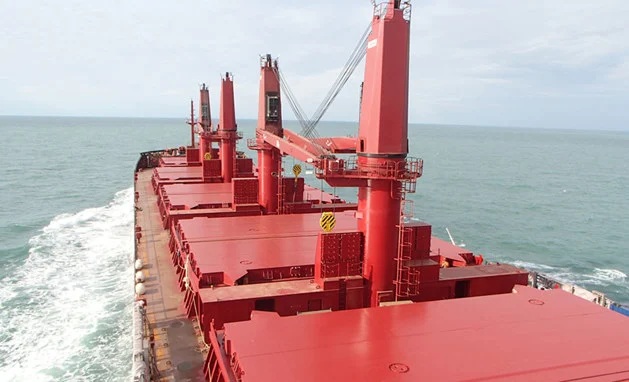
V. Electric Option – A Greener Alternative
While hydraulic cranes dominate heavy‑duty applications, electric cranes are gaining ground. They offer:
Simple operation
Low noise and low energy consumption
Zero emissions
For extreme loads and harsh sea conditions, hydraulic remains the preferred choice. For environmentally sensitive ports, electric is increasingly attractive.
A marine crane works by converting engine power into hydraulic pressure, precisely controlling oil flow to cylinders and motors, and executing hoisting, luffing, and slewing motions. It is a perfect integration of hydraulics, electronics, and mechanical design – delivering the power to lift heavy loads with the precision to place them exactly where needed.
Post time: Jul-28-2026